
The Emergence of Gravity
Abstract
The Predictive Universe (PU) framework proposes, on its operational-continuum and local-KMS branch, that gravity is an emergent thermodynamic phenomenon arising from a universal network of information-processing agents (Minimal Predictive Units, or MPUs). Governed by a drive for maximum predictive efficiency, this network self-organizes into geometrically regular finite-resolution structures whose macroscopic closure behaves as spacetime. The framework derives the horizon entropy Area Law from irreversible information limits of MPU interactions, supplying a candidate microscopic basis for the entropy input that Jacobson (1995) used, an input traceable to Bekenstein (1973) and Hawking (1975) and generalized in the holographic bound of Bousso (2002). By treating the energy cost of prediction as heat and applying thermodynamic laws on local causal horizons, Einstein Field Equations emerge as the macroscopic equation of state that keeps the system in balance. Gravity, in this view, is the geometric response of spacetime to the distribution of predictive work. The same branch models black holes as informational boundaries and treats dark-sector effects through environment-dependent gravitational response kernels pending quantitative tests.
For a more detailed exploration of these ideas including visualizations:
get the full paper (GitHub).
Gravity in Plain Terms
Nobody derives the pressure of a gas by tracking every molecule. Pressure, temperature, and the gas law are what you get when you stop tracking and start counting: how much energy, how many degrees of freedom, how much room. The law is exact and the molecules never appear in it.
The proposal here is that gravity is a law of that kind. The molecules are units that predict, check, and update, and what gets counted is how much distinguishable information can cross a boundary. That count turns out to grow with the boundary's area rather than the volume behind it, which is the surprising part and the part that does the work. A doorway lets through traffic in proportion to its width, and the size of the room behind it makes no difference.
Once the count is fixed, an old thermodynamic move becomes available. Heat crossing a surface, divided by temperature, gives entropy change. Insist that this holds at every point and in every direction, and the geometry has nowhere left to move: it has to bend in exactly the way Einstein's equations describe. Jacobson showed this in 1995. What is added here is a candidate account of where the entropy count comes from.
The conditions are worth keeping in view, because each is a real assumption. The network has to be geometrically regular. The information count has to saturate its bound rather than merely respecting it. Each small region has to be in local thermal equilibrium. And these have to hold together on one consistent description, which the framework states as a criterion it has not yet certified.
1. The Enigma of Gravity
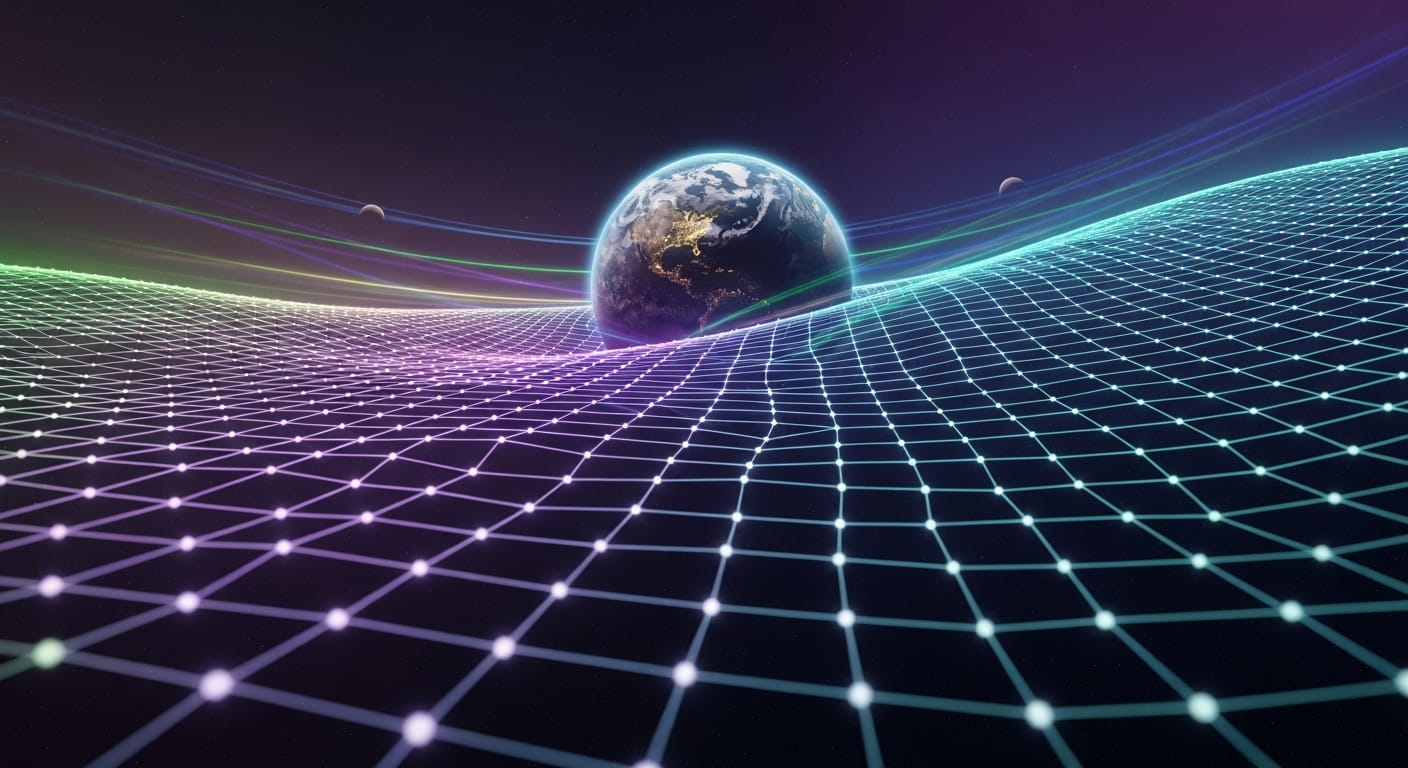
A persistent schism divides modern fundamental physics. On one side stands General Relativity (GR), Einstein's monumental theory of gravity, a masterpiece of classical physics that recast gravity, in Einstein's (1915) field equations, as the dynamic curvature of spacetime itself. Imagine a cosmic fabric, smooth and continuous, whose geometry is directly influenced by the presence of matter and energy. Planets orbit the sun because the sun's mass warps the spacetime around it, guiding the planets along the shortest paths within that curved geometry. GR describes a deterministic universe of immense scales, where space and time are inextricably linked, and phenomena unfold with a continuous flow. It has been confirmed with astonishing precision, from the bending of starlight around massive objects to the existence of gravitational waves rippling through the fabric of the universe.
On the other side is Quantum Field Theory (QFT), the bedrock of the Standard Model of particle physics. QFT describes the other three fundamental forces - the strong, weak, and electromagnetic interactions - through the probabilistic exchange of discrete, force-carrying quanta (particles like photons for electromagnetism or gluons for the strong force). It's a world where energy and matter exist in quantized packets, where particles can be in multiple states at once (superposition), and where distant particles can be instantly linked by entanglement. This theory operates on the microscopic, subatomic scale, treating spacetime as a fixed, static background stage upon which quantum events probabilistically unfold.
The inherent languages and foundational assumptions of these two pillars are fundamentally incompatible. GR speaks of continuous geometry, smooth fields, and deterministic trajectories (at the classical level). QFT speaks of discrete quanta, probabilistic outcomes, and interactions mediated by particle exchange, all occurring on a non-dynamic spacetime. This conceptual divide becomes an impassable chasm at the most extreme frontiers of physical reality:
- Black Hole Singularities: At the heart of a black hole, GR predicts a singularity - a point where spacetime curvature and density become infinite, and its equations break down. Here, matter is crushed to an inconceivable degree, and quantum effects must surely dominate, yet QFT cannot describe gravity in this context.
- The Big Bang: Similarly, at the very beginning of the universe, all matter and energy were compressed into an incredibly hot, dense state. This primordial singularity is another regime where GR and QFT violently clash, unable to offer a coherent picture of creation.
- The Nature of Spacetime Itself: QFT treats spacetime as a passive arena. However, if gravity is quantized, then spacetime itself must become a quantum entity, subject to fluctuations and probabilistic behavior. How can a "quantum spacetime" behave as the fixed background for other quantum fields? This fundamental inconsistency highlights the deep conceptual rift.
The quest to unify these two triumphant yet contradictory descriptions into a single, coherent theory of quantum gravity remains the most significant unsolved problem in physics, representing the ultimate challenge to our understanding of the universe. Generations of physicists have dedicated their careers to this pursuit, attempting to bridge this divide. The persistent, almost intractable difficulty of this problem suggests a radical possibility: the current framing may be the flaw. Gravity may be something other than a fundamental force to be quantized in the same manner as the other forces, and instead an emergent phenomenon, or an equation of state, arising from a deeper layer of reality.
Universe 00110000
2. The Quest for Quantum Gravity
The journey to understand gravity began with Newton's universal law, a clockwork picture of instantaneous action at a distance. This was shattered by Einstein's revelation: gravity is a manifestation of spacetime's geometry. Matter tells spacetime how to curve, and curved spacetime tells matter how to move. This beautiful, dynamic picture has been verified with breathtaking precision. Yet, it describes a classical, deterministic world at odds with the quantum realm.
The challenge of quantum gravity is to reconcile these two pictures. The main avenues of research have taken two distinct approaches:
- String Theory starts from the quantum side. It posits that the fundamental constituents of reality are tiny vibrating strings in higher dimensions rather than point particles. Different vibrational modes of these strings appear to us as different particles - the electron, the photon, and, crucially, the graviton, the quantum of gravity. In this view, gravity is a fundamental force, just like the others, emerging from the quantum mechanics of a more basic entity.
- Loop Quantum Gravity (LQG) starts from the gravity side. It attempts to apply quantum rules directly to Einstein's geometry. In LQG, spacetime itself is quantized, woven from discrete loops into a "spin network." At the smallest scale, there is no smooth fabric, only a granular, quantum geometry from which classical spacetime emerges at large scales.
Both theories offer deep mathematical insight, and they face immense challenges and have yet to produce experimentally testable predictions that distinguish them. The Predictive Universe framework proposes a third path. It suggests that both quantum mechanics and gravity are emergent phenomena, arising from a deeper layer of reality governed by the principles of information, prediction, and optimization.
3. Whispers of Emergence: A Thermodynamic Clue
A revolutionary clue to the nature of gravity emerged in the 1970s from the study of black holes. The work of Bekenstein and Hawking revealed an astonishing connection between the geometry of a black hole's event horizon and the laws of thermodynamics. They showed that a black hole possesses entropy proportional to the area of its horizon, and that it radiates energy as if it were a thermal object with a specific temperature. This was the first hint that gravity, at its deepest level, might be a macroscopic thermodynamic phenomenon, much like heat and temperature are emergent properties of the microscopic motion of atoms.
In 1995, Ted Jacobson took this idea to its logical conclusion. He demonstrated that if one assumes the entropy of any local causal horizon is proportional to its area (the Area Law) and that the fundamental Clausius relation of thermodynamics (δQ = T δS) holds, then Einstein's Field Equations can be derived as a simple equation of state. In this view, gravity is not fundamental; it is an emergent consequence of the universe demanding local thermodynamic consistency. However, Jacobson's powerful argument began by assuming the Area Law. It did not explain why horizon entropy should be proportional to area, leaving the microscopic origin of this relationship a mystery.
4. The Emergent Gravity Paradigm: 'It from Bit' and Entropic Forces
Jacobson's work was part of a growing paradigm shift in physics, moving away from a substance-based view of reality toward an information-based one. This movement was famously encapsulated by physicist John Archibald Wheeler's maxim, "it from bit," which posits that every physical thing - every particle, every field of force, even spacetime itself - derives its existence and its meaning from the answers to yes-or-no questions, or bits of information.
This information-centric view was powerfully reinforced by the holographic principle. First proposed by Gerard 't Hooft and further developed by Leonard Susskind, the principle emerged from the deep puzzles of string theory and black hole physics. It suggests that the information content of any volume of space can be fully described by a theory living on its boundary, much like a three-dimensional image (a hologram) is encoded on a two-dimensional surface. This principle implies that our perception of a three-dimensional universe might be a projection of information stored on a distant, lower-dimensional screen.
Building on these ideas, Verlinde (2011) proposed that gravity is an entropic force, and Padmanabhan (2010) surveys the wider case for reading the field equations thermodynamically. He argued that gravity is an emergent phenomenon related to the information associated with the position of material bodies rather than a fundamental interaction. In his model, the tendency for systems to move toward states of higher entropy manifests as the force we call gravity. Much like a stretched rubber band pulls back because the contracted state is entropically favored rather than through any fundamental attraction, masses "attract" each other because their proximity is a state of higher entropy for the underlying information screen of the universe.
These approaches - thermodynamic, holographic, and entropic - all point toward a universe where gravity is an emergent, macroscopic effect. Yet, like Jacobson's derivation, they often begin with high-level principles like the Area Law or holography without providing a complete, bottom-up derivation from a fully specified microscopic theory. They provide compelling evidence for what gravity is, but not a full explanation of why the universe must be this way.
5. The Predictive Universe Solution: Deriving Gravity from First Principles
The Predictive Universe (PU) framework aims to provide this missing microscopic foundation. It does not start by assuming the Area Law at the microscopic level; on its geometrically regular branch, it derives horizon area proportionality from the fundamental information-theoretic limits of its constituents. The emergence of gravity within PU is a multi-step, conditional derivation rooted in the logic and resource economics of prediction.
5.1 The Substrate: A Network of Predictors
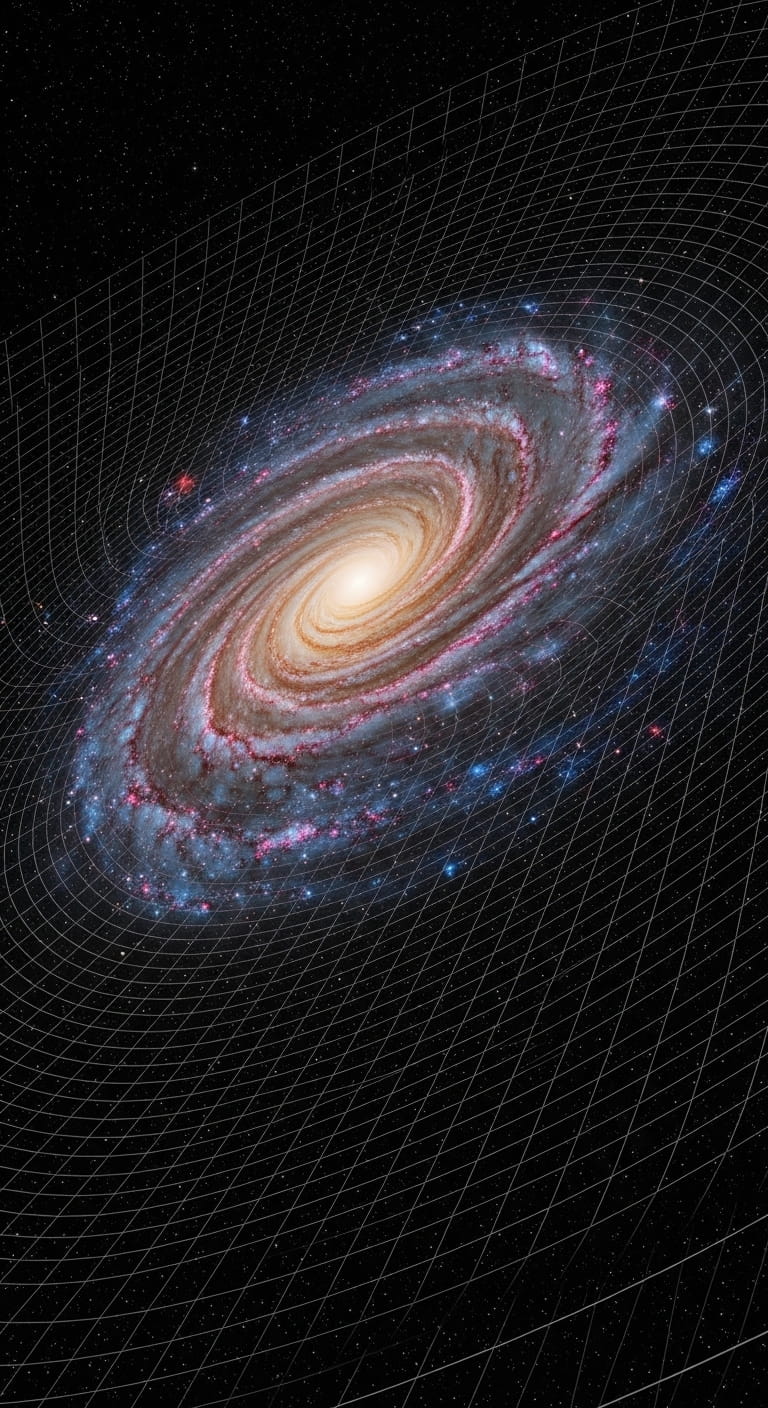
At the foundational level of PU, there is no pre-existing spacetime. Reality is constituted by a dynamic, relational network of Minimal Predictive Units (MPUs). These are the building blocks of reality, each a tiny, self-referential predictive system operating cyclically. The "distance" between any two MPUs is a dynamic quantity, defined by the cost and difficulty of propagating predictive information between them. This cost is a real, physical metric, quantified by the fidelity loss and irreducible thermodynamic cost of the interaction. This network of relationships is a discrete structure; all geometric notions like 'length', 'curvature', and 'dimension' must emerge from it.
Universe 00110000
5.2 Efficiency and the Emergence of Spacetime
The MPU network is not static. This process is a prime example of the Principle of Physical Instantiation (PPI) at work. The abstract, logical requirement is that for a universe to be coherently predictable, it must have a stable, regular medium for information to propagate through. The PPI dictates that this logical necessity, when physically embodied by the MPU network, will be shaped by resource optimization.
The network's evolution is governed by the Principle of Compression Efficiency (PCE) - the specific physical mechanism that enforces this optimization. The framework argues that PCE strongly penalizes incoherent, unstable, or highly disordered propagation structures: information gets lost, predictions lose coherence over distance, and maintaining the system requires exorbitant costs. Consequently, viable branches are driven toward geometrically regular metric-network configurations. These configurations support stable propagation, finite-resolution distance, and maximal predictive utility at macroscopic scales.
At finite macroscopic resolution, these regular branches admit an operational continuum description that behaves like a smooth Lorentzian spacetime manifold. Spacetime, therefore, is the thermodynamically efficient physical solution to the logical problem of creating a stable stage for prediction.
5.3 The Engine of Irreversibility: Information Limits, the Area Law, and the Arrow of Time
The interactions between MPUs, known as the 'Evolve' process, are not perfect exchanges of information. They are fundamentally irreversible and information-limited, a direct consequence of the logical paradoxes of self-reference that lie at the heart of each MPU's predictive cycle. Every 'Evolve' interaction incurs a strictly positive thermodynamic cost ε > 0; for a registered cyclic reset, that cost obeys εphys ≥ Hq(P | R), reaching ln 2 per bit on the unbiased, overhead-free branch that saturates the erasure floor Landauer (1961) established. This cost acts as a thermodynamic ratchet. On the branch carrying a common forward and reverse event algebra with a positive pathwise entropy-production certificate, it supports the unidirectional flow of time, giving a microscopic, dynamical basis for the arrow of time. On the other hand, it makes each interaction a "lossy" information channel with a finite, unbreachable capacity.
This information bottleneck is the key to deriving the Area Law. When we consider a causal boundary, like an event horizon, it acts as a screen through which information must pass via these limited channels. The total amount of distinguishable information that can be encoded on or passed through the boundary is therefore proportional to the number of fundamental interaction channels that pierce its surface. Since the network is geometrically regular, the number of these channels is directly proportional to the area of the boundary. This gives the horizon entropy area law: the entropy of a region is bounded by its boundary area. Four conditions carry the result and are worth separating. Geometric regularity and a density certificate give the bound. Equality, with the definite coefficient, additionally needs the residual-budget saturation branch and the capacity-achieving, entropy-saturating, additive-ledger branch. Off those branches what remains is an upper bound rather than the law with its coefficient.
The constant of proportionality in this area law defines the emergent operational coupling Gop, whose identification with the measured gravitational constant is a separate physical calibration, linking it directly to the microscopic parameters of the MPU network, such as the effective MPU spacing (δ) and the channel capacity (Cmax), while the field-equation derivation itself requires only area proportionality. In PU, the strength of gravity is fixed by the effective horizon information density of the substrate and inversely related to it: lower effective information density produces a stronger effective gravitational response.
Smax = kB A / (4 LP2)
(The Area Law, derived from MPU information limits)
5.4 The Equation of State: Gravity from Local Thermodynamic Consistency
With the Area Law in hand, and under the following assumptions - (i) local thermodynamic equilibrium with Unruh temperature on local Rindler horizons; (ii) horizon entropy proportional to area with a fixed coefficient; (iii) applicability of the linearized Raychaudhuri equation with appropriate initial data; and (iv) validity for all null generators - the final step follows Jacobson (1995). The PU framework identifies the flow of "heat" (δQ) across a local horizon with the flux of the macroscopic MPU Stress-Energy Tensor (Tμν(MPU)). The tensor is the coarse-grained density and flow of the resource costs, complexity, computation, and interaction energy, that the network is optimizing. It is the energy of predictive work.
On the local KMS/LTE branch, the framework applies the Clausius relation, δQ = T δS, to every infinitesimal patch of every local causal horizon. The relation has three ingredients:
- δS is determined by the change in horizon area via the derived Area Law.
- T is the local Unruh (1976) temperature associated with the horizon, representing the thermal noise experienced by an accelerating observer.
- δQ is the flux of energy associated with the MPU network's predictive activity.
Requiring the relation for all local null horizons constrains the geometry: the curvature has to respond to the distribution of stress-energy, and the response is Einstein's field equations. The implication is conditional, and the framework lists what it needs on one compatible description: the operational continuum, the Lorentzian promotion, a finite local equilibrium state, the area normalization, a conserved source, and the local-horizon and zero-slack records. The framework supplies that closure criterion and records that no accepted joint certificate for it currently exists.
Rμν - ½ R gμν + Λ gμν = (8πG / c4) Tμν(MPU)
The EFE emerge as the macroscopic equation of state for the emergent spacetime manifold, ensuring that the geometry always adapts to maintain local thermodynamic consistency with the underlying information-processing dynamics of the MPU network.
5.5 The Scale of Gravity: A Summary Formula
Gravity therefore appears as a macroscopic, thermodynamic consequence of predictive-network dynamics, with its scale fixed by the underlying MPU information parameters, succinctly summarised by:
where ΣI = σeff link Cmax(fRID) represents the effective horizon information density. This crucial term combines the effective surface density of independent information channels, σeff link (with dimensions L-2), and the dimensionless channel-capacity bound of the underlying interactions, Cmax. The effective surface density σeff link is determined by the effective MPU spacing δ, a geometric packing factor η, and a correlation factor χ (where χ ≤ 1) that accounts for non-independence between channels, typically scaling as σeff link = χ/(ηδ2). The capacity Cmax is bounded by the retained channel support of the minimal carrier, Cmax ≤ ln d0 − ln 2, a statement about how much distinguishable structure a completed cycle can carry rather than about dissipated heat.
6. Implications of Emergent Gravity: Beyond the Standard Picture
Deriving gravity from the thermodynamics of prediction has consequences beyond a reinterpretation of Einstein's equations. This emergent view offers novel perspectives on some of the deepest puzzles in physics: the nature of black holes and the mystery of the "dark sector" of the cosmos.
6.1 Black Holes as Informational Boundaries
In the PU framework, black holes are the ultimate expression of the universe's informational limits. The event horizon is a boundary where the MPU network's capacity to process and transmit distinguishable information reaches saturation. This perspective provides a new lens through which to view the Black Hole Information Paradox.
The paradox arises because the seemingly thermal nature of Hawking radiation implies that information about what fell into the black hole is permanently lost, violating the quantum principle of unitarity. The PU framework reframes this as a problem of expansive reflexivity. An external observer attempting to decode the information by measuring outgoing Hawking radiation is engaged in a reflexive process: each measurement extracts energy and changes the black hole's state. As the black hole evaporates, its dynamics accelerate, and the impact of each measurement becomes proportionally larger. The "problem" of the black hole's state changes faster than the "solution" can be extracted through local sequential measurement, obstructing recovery on this channel.
The PU framework proposes that each quantum emission ('Evolve' event) produces a particle together with a specific interaction context, or perspective. The information of the initial state is not deleted at the retained global-response level; it is carried in highly correlated perspective structure across the black hole's lifetime. This proposed Perspectival Information Channel bypasses the reflexive loop of local sequential recovery while remaining consistent with no deterministic faster-than-light signaling and AQFT locality. Exterior recovery from the radiation, and a full Page-curve account, require additional scrambling and continuity conditions. An observer who could measure only the energy of the radiation would see a thermal bath, while the retained information remains hidden in the contextual fabric of the emission process.
6.2 The Dark Sector: Gravity's Adaptation to Information
The most radical implication of emergent gravity is that the gravitational "constant," G, is a macroscopic parameter of the MPU network. It is set by the effective horizon information density, which depends on MPU spacing δ, effective channel density, and information capacity Cmax. Because the network is governed by the Principle of Compression Efficiency, these parameters can adapt to the local information environment within the allowed branch constraints.
At galactic scales, this gives a model for phenomena attributed to dark matter, and it enters the territory of the acceleration-scale regularity that Milgrom (1983) identified. In dense regions of the universe, like the core of a galaxy, there is a rich stream of information to predict. PCE favors a high-performance configuration: densely packed MPUs with high-capacity communication channels. In the sparse, information-poor regions of a galaxy's outskirts, maintaining such a costly network is inefficient. PCE can drive parameter relaxation: the effective MPU spacing δ increases, the effective channel density decreases, and the channel capacity Cmax can decrease. Since G is inversely related to ΣI, these changes can raise the effective gravitational response at large galactic radii.
At galactic scales, the PU model expresses this response through an environment-dependent law-modification kernel G(R), constrained by local-gravity limits and acceleration-scale regularities. It can behave like an effective dark-matter halo and can reproduce key regularities, for example the radial-acceleration relation, without introducing new particles. The kernel remains a model-level phenomenological closure pending quantitative tests against rotation curves, lensing, and clusters. At cluster scales, PU treats the response through a separate non-local source-modification kernel, often described as predictive matter, distinct from the galaxy-scale G(R) kernel. On cosmological scales, the phenomenon labeled dark energy may reflect slow, global adaptation of the MPU network parameters to the evolving mean density. The dark sector remains a model branch tied to gravity adaptation and empirical constraints.

Universe 00110000
7. Conclusion
The Predictive Universe framework offers a conditional first-principles pathway to emergent gravity. It treats gravity as a macroscopic thermodynamic phenomenon derived from predictive-network dynamics. Spacetime is the finite-resolution geometric stage built by a network of predictive agents optimizing for efficiency. The Area Law follows from information limits in irreversible interactions. Einstein Field Equations emerge as the macroscopic equation of state that keeps geometry in local thermodynamic consistency with predictive work performed by the MPU network. This thermodynamic origin for gravity follows from the framework premise that reality is an informational process and that physical laws are resource-efficient rules for that process. Black holes and dark-sector effects become test cases for the branch, with their status determined by quantitative fit and independent constraints.
References
- Bekenstein, Jacob D. "Black Holes and Entropy." Physical Review D 7, no. 8, 1973, 2333–2346.
- Bousso, Raphael. "The Holographic Principle." Reviews of Modern Physics 74, no. 3, 2002, 825–874.
- Einstein, A. "Die Feldgleichungen der Gravitation." Sitzungsberichte der Preussischen Akademie der Wissenschaften, 1915, 844–847.
- Hawking, S. W. "Particle Creation by Black Holes." Communications in Mathematical Physics 43, no. 3, 1975, 199–220.
- Jacobson, Ted. "Thermodynamics of Spacetime: The Einstein Equation of State." Physical Review Letters 75, no. 7, 1995, 1260–1263.
- Landauer, Rolf. "Irreversibility and Heat Generation in the Computing Process." IBM Journal of Research and Development 5, no. 3, 1961, 183–191.
- Milgrom, M. "A Modification of the Newtonian Dynamics as a Possible Alternative to the Hidden Mass Hypothesis." The Astrophysical Journal 270, 1983, 365–370.
- Padmanabhan, T. "Thermodynamical Aspects of Gravity: New Insights." Reports on Progress in Physics 73, no. 4, 2010, 046901.
- Unruh, W. G. "Notes on Black-Hole Evaporation." Physical Review D 14, no. 4, 1976, 870–892.
- Verlinde, Erik. "On the Origin of Gravity and the Laws of Newton." Journal of High Energy Physics 2011, no. 4, 2011, 29.