
The Black Hole Information Paradox: A Predictive Universe Perspective
Abstract
The Black Hole Information Paradox highlights a deep conflict between general relativity and quantum mechanics, suggesting that information may be permanently destroyed in violation of quantum unitarity. The Predictive Universe framework recasts the problem as a limitation in computability rooted in reflexive measurement. Retrieving information from a black hole becomes a problem in which measurement dynamically alters the system being measured. The framework proposes that information is preserved through a Perspectival Information Channel carried by the sequence of interaction contexts. Under the required horizon-certification and finite-response conditions, this mechanism is intended to reproduce Page-curve behavior for entanglement entropy.
The Paradox in Plain Terms
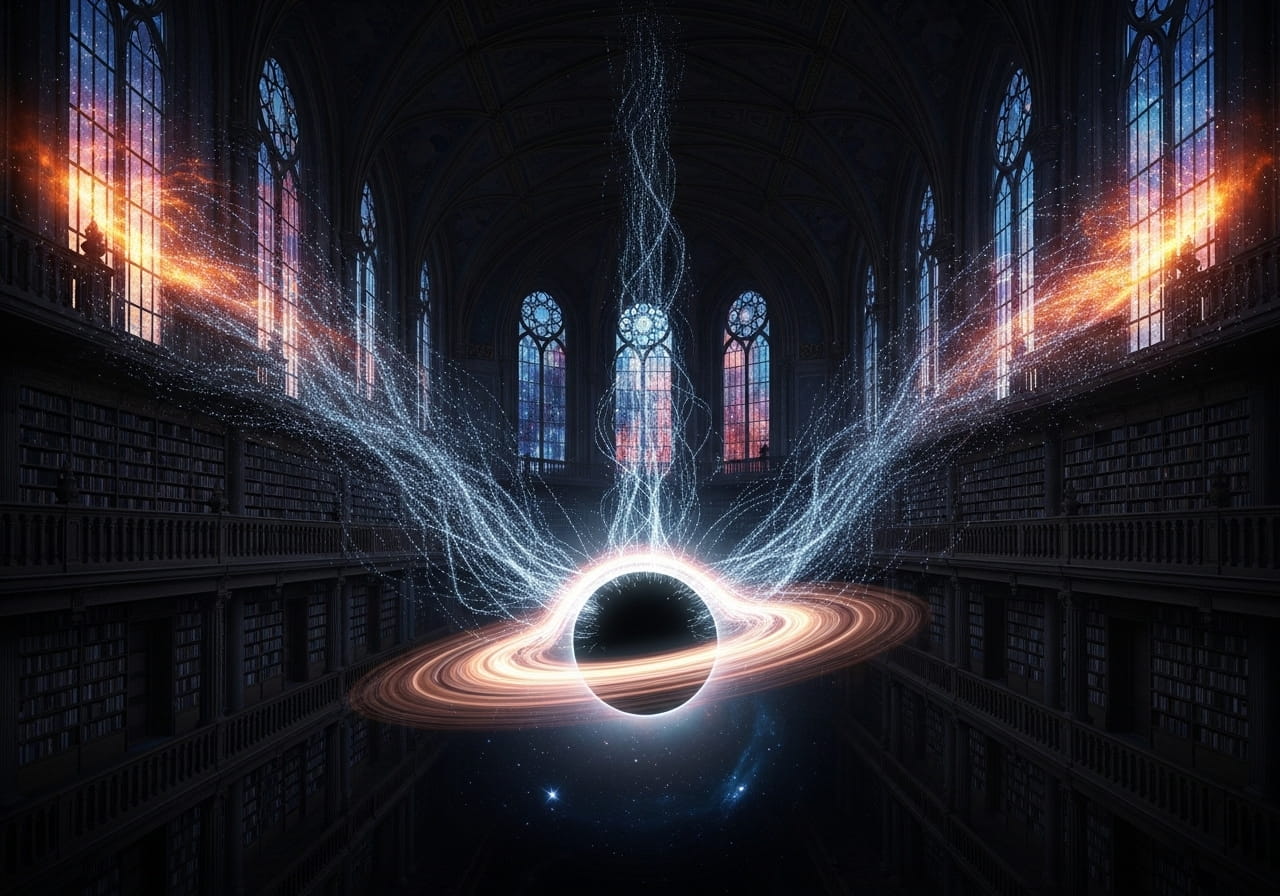
Burn a library and the information is not really gone. It is in the smoke, the ash, and the heat, in a form nobody can read but which the laws of physics say is still there in principle. Run the physics backwards from a perfect record of the smoke and you get the books back.
Black holes appear to break that. Hawking showed they radiate, and the radiation looks the same whatever fell in. A black hole fed a library and one fed an equal mass of hydrogen glow alike. When the hole finishes evaporating there is nothing left to hold the difference, so the difference appears to have been destroyed, which quantum mechanics says cannot happen.
The proposal here is that the information is being looked for in the wrong place. Every emission has two parts: the particle that comes out, and the context that fixed which question the emission answered. Measuring only the particles gives thermal noise. The sequence of contexts is where the structure is, and an observer who tracks only the first channel sees loss because the second is not being read.
There is a further problem, and it is about the act of looking. Measuring a black hole changes it, since anything you use to probe it falls in or disturbs the horizon, so the object at the second measurement is not the one the first measurement described. So the task loops back on itself, and a task that loops back on itself has no settled answer of the kind the paradox demands.
What follows names its conditions, which is what makes it checkable. The claim that distinct histories stay distinct rests on one property of the horizon update, stated rather than assumed silently, and the curve that entropy should follow rests on two further conditions of the same kind. Each is a specific thing to establish, and each fails visibly if it does not hold.
1. Introduction
When Hawking (1975) showed that black holes radiate, he uncovered one of the deepest puzzles in modern physics. According to General Relativity, a black hole is a simple object, characterized only by its mass, charge, and spin - the "no-hair theorem." A core principle of quantum mechanics, unitarity, insists that information is never erased. Bekenstein (1973) had already assigned a black hole an entropy proportional to its horizon area, which made the question quantitative. If you know the final state of a system, you can, in principle, reconstruct its entire history.
Hawking's (1976) calculations created a direct conflict. He showed that the radiation emitted as a black hole evaporates appears to be thermal and almost completely featureless, carrying no memory of the rich, specific information it consumed (e.g., whether it was formed from a star or a library of books). When the black hole is gone, the information seems to be gone with it, permanently deleted from the cosmos. This is the Black Hole Information Paradox in its starkest form: it suggests a fundamental violation of quantum mechanics, pitting the relentless gravity of Einstein against the information-preserving laws of the quantum world.
Resolving it means rethinking the relation between spacetime, information, and measurement. The mainstream routes make different moves: complementarity holds that no single observer sees a contradiction (Susskind, Thorlacius, and Uglum 1993), the holographic correspondence encodes the interior in a boundary theory that is manifestly unitary (Maldacena 1998), and the firewall argument shows that the natural assumptions cannot all hold at once (Almheiri et al. 2013). Recent work recovers the entropy curve from gravitational path integrals (Penington 2020). The Predictive Universe framework proposes that the appearance of information loss comes from using only local sequential measurements of the amplitude channel. On the perspectival-channel account, global information is preserved in the sequence of contexts associated with the emission process.

Universe 00110000
2. The Paradox of a Reflexive Problem
The framework reframes the information-retrieval task as a computational process as well as a physical one. An external observer tries to solve the "problem" of reconstructing the initial state of the matter that formed the black hole by performing a series of measurements. Viewed this way, the task has a structural flaw.
2.1 Information Retrieval as a Reflexive Problem
A reflexive problem is one where the act of trying to find the solution changes the problem itself. This is precisely what happens when we try to measure a black hole's information content. The process unfolds as follows:
- The Problem Instance: The full, scrambled internal quantum state of the black hole at a given moment, encoding the history of all infalling matter.
- The Solution Attempt: The act of an external observer measuring one quantum of Hawking radiation. This interaction provides a tiny piece of information about the black hole's state.
- The Instance Transformation: This is the crucial step. By emitting a quantum, the black hole loses mass-energy. Its internal state is fundamentally altered by the very measurement meant to probe it. The problem instance for the next measurement is now different from the one that was just measured.
This creates a feedback loop. Every measurement a physicist makes to learn about the black hole's past intrinsically alters its future. This dynamic is a core feature of reality in the PU framework, formalized as Reflexive Interaction Dynamics. However, for a late-stage black hole, this loop is not stable - it is expansive.
2.2 Expansive Reflexivity: The Computational Abyss
As a black hole evaporates, its dynamics accelerate. Its temperature (TH ∝ 1/M) skyrockets, and its rate of mass loss (dM/dt ∝ -1/M2) explodes. This means the relative impact of each measurement grows wildly. Measuring a single Hawking quantum from a tiny, late-stage black hole represents a huge fractional change to its remaining mass and internal state.
This creates what the PU framework calls expansive reflexivity. The problem instance - the black hole's state - "runs away" from the observer's model faster than they can collect data. Each solution attempt (measurement) pushes the problem into a new, more volatile state, creating a computational infinite regress. Trying to reconstruct the full information locally and sequentially is like trying to map the coastline of an island that's dissolving into the sea at an accelerating rate - the very act of mapping is being undone faster than it can be performed. This is a physical manifestation of the fundamental logical limits of self-reference, akin to the Self-Referential Paradox of Accurate Prediction (SPAP), a universal logical limit that applies to any complex system attempting to perfectly predict its own future. The paradox of information loss is thus revealed to be a symptom of a deeper paradox: the impossibility of perfectly modeling a system whose state is expansively altered by the modeling process itself.

Universe 00110000
3. The Solution
The framework's account leaves the reflexive loop in place and locates the information in a second channel, one that local measurement of the emitted particles does not read.
3.1 The Dual Nature of Quantum Emission: 'Evolve' and the Perspectival State
According to the PU framework, the state of any fundamental entity (a Minimal Predictive Unit or MPU) is a Perspectival State, a pair consisting of its quantum state amplitude and its "perspective" - the interaction context or measurement basis. The emission of a Hawking quantum is a physical realization of the MPU's fundamental interaction process, called 'Evolve'. The process has two outputs:
- The Amplitude (`|k>`): The familiar quantum particle itself - a photon, a graviton, etc. - selected probabilistically according to the Born Rule from the black hole's scrambled internal state. This is what we observe and what appears thermal.
- The Perspective (`s'`): A new interaction context or basis. This "perspective" can be thought of as the specific question the universe asks of the black hole at the moment of emission. This is the hidden part of the process. The choice of this perspective is not random; it is drawn from a probability distribution that is critically dependent on the full information content of the black hole's internal state at the moment of emission.
3.2 The Perspectival Information Channel
This proposes a second accounting channel for black hole information. While the sequence of amplitudes |k1>, |k2>, |k3>, ... looks random and thermal, the accompanying sequence of perspectives s1, s2, s3, ... is highly structured and non-random. It carries the response-context information the global unitary account requires. The premise doing the work is that the retained horizon update is injective, so distinct retained response classes are never merged. That premise is branch-local rather than a consequence of horizonhood, which is what makes it the thing to test: injectivity of the retained update is a property of a specific horizon dynamics, and the protocol, capacity, clock and extraction-cost certificates are the four constructions that settle it.
On this account, the information is encoded in the context of each quantum actualization. An observer limited to measuring only the properties of the emitted particles will perceive thermal radiation and information loss.
4. A Critical Consistency Check: The Page Curve
Any proposed solution has to be consistent with established results in quantum information theory, and the benchmark is the Page (1993) curve, which describes how the entanglement entropy of the Hawking radiation should evolve over a black hole's lifetime. Initially the entropy of the radiation grows as it becomes more entangled with the remaining black hole, and Hayden and Preskill (2007) showed how quickly information deposited in an old black hole can in principle be recovered from the radiation. For unitarity to be preserved, however, this entropy must eventually decrease and return to zero when the black hole has fully evaporated. This "rise and fall" is the signature of information preservation.
The framework's mechanism is intended to match this behavior under the required finite-response and horizon-certification conditions. By modeling black hole evaporation as a sequence of informationally constrained emission events, the account seeks to bound the radiation entropy so that it follows the expected rise-and-fall pattern of the Page Curve. The result is branch-dependent support for the Perspectival Information Channel, and the branch it depends on is stated: the finite-response and horizon-certification conditions named above are what the account needs and what a test would target.

Universe 00110000
5. Conclusion
From the viewpoint of the Predictive Universe, the Black Hole Information Paradox is a lesson about the limits of knowledge. The apparent loss of information is an artifact of a measurement strategy doomed by the expansive reflexivity of the system it tries to probe.
- The Paradox is a computability limit. It highlights a fundamental inability for any local, sequential process to fully model a system that is expansively transformed by observation.
- Information preservation is branch-conditional. Global unitarity is maintained when the full sequence of interaction contexts is included, and Page-curve behavior is expected under the required certification conditions.
- Information escapes via the Perspectival Channel. The record is carried by the highly specific, non-random sequence of contextual "sparks" that accompany each emission. The thermal amplitudes alone do not hold it.
The black hole does not erase the past on this account. The relevant information is encoded in the sequence of quantum contexts. Thermal particle amplitudes alone do not contain the full record.
References
- Almheiri, Ahmed, Donald Marolf, Joseph Polchinski, and James Sully. "Black Holes: Complementarity or Firewalls?" Journal of High Energy Physics 2013, no. 2, 2013, 62.
- Bekenstein, Jacob D. "Black Holes and Entropy." Physical Review D 7, no. 8, 1973, 2333–2346.
- Hawking, S. W. "Particle Creation by Black Holes." Communications in Mathematical Physics 43, no. 3, 1975, 199–220.
- Hawking, S. W. "Breakdown of Predictability in Gravitational Collapse." Physical Review D 14, no. 10, 1976, 2460–2473.
- Hayden, Patrick, and John Preskill. "Black Holes as Mirrors: Quantum Information in Random Subsystems." Journal of High Energy Physics 2007, no. 9, 2007, 120.
- Maldacena, Juan. "The Large N Limit of Superconformal Field Theories and Supergravity." Advances in Theoretical and Mathematical Physics 2, no. 2, 1998, 231–252.
- Page, Don N. "Information in Black Hole Radiation." Physical Review Letters 71, no. 23, 1993, 3743–3746.
- Penington, Geoffrey. "Entanglement Wedge Reconstruction and the Information Paradox." Journal of High Energy Physics 2020, no. 9, 2020, 2.
- Susskind, Leonard, Lárus Thorlacius, and John Uglum. "The Stretched Horizon and Black Hole Complementarity." Physical Review D 48, no. 8, 1993, 3743–3761.