
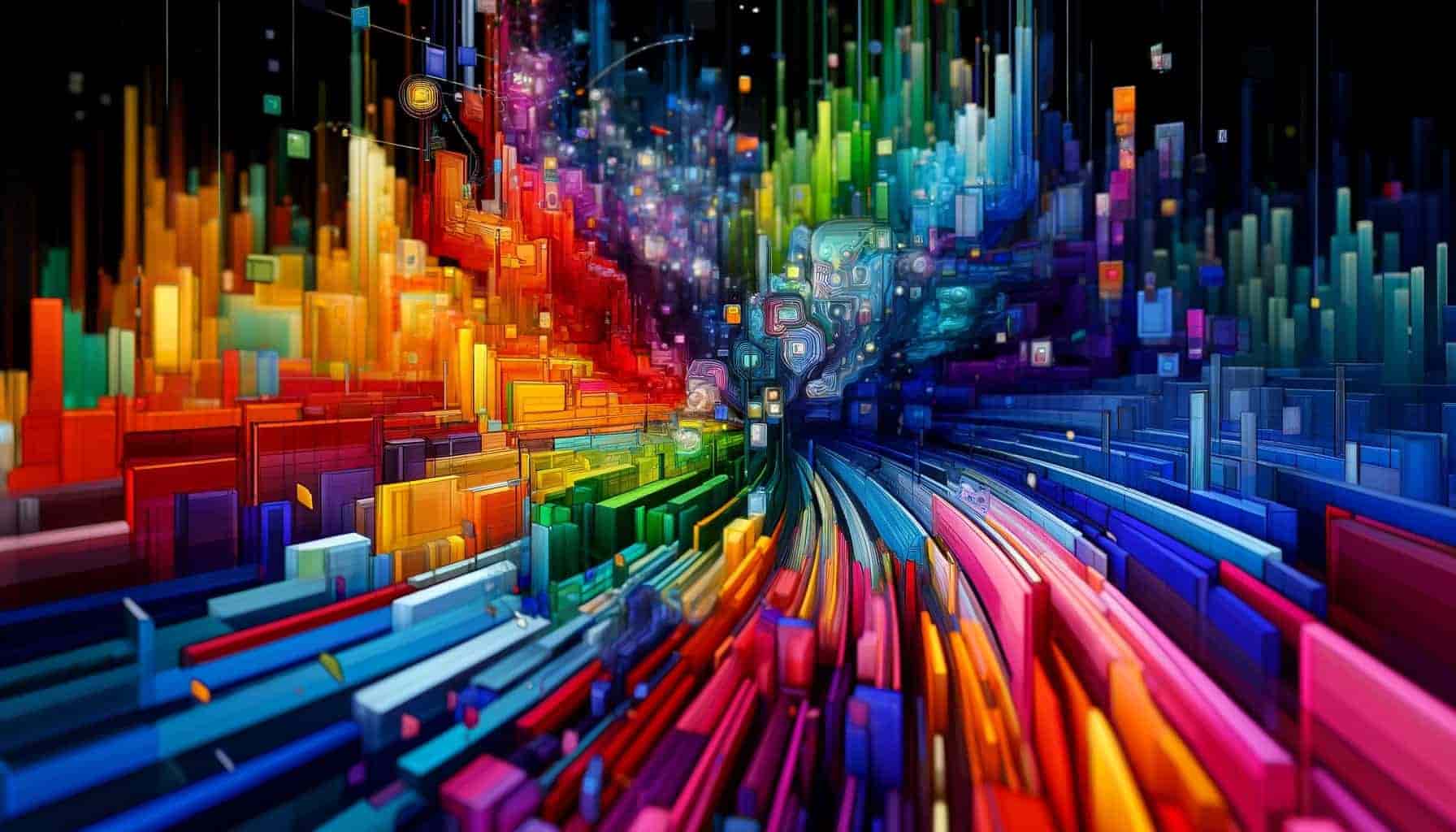
Synesthetic: Unveiling the Hidden Connections Between Color and Language
Synesthetic maps the connections between colour and language using large language models. The aim is a colour-word translator that connects visual perception with linguistic expression, built from the associations that appear in ordinary usage.
The Idea in Plain Terms
Ask a room full of people which colour is angry and most will say red, an association Palmer et al. (2013) traced through emotion rather than direct perception. Ask which is calm and most will say blue. Nobody taught them a rule, and the agreement is strong enough to build on.
Some of that agreement has a physical basis. Red is blood and heat, blue is water and distance, and bodies react to both before any word is involved. Some of it is cultural, which is why white is a funeral colour in some places and a wedding colour in others. Berlin and Kay (1969) found that even the basic colour terms appear in a constrained order across languages, so the cultural part is patterned too. Any system that maps words to colours has to handle both, and has to say which it is relying on.
Language models are useful here because they place words by how they co-occur in use (Mikolov et al. 2013), and rated scales of the kind Osgood, Suci, and Tannenbaum (1957) introduced give the same associations a measurable form, so their associations reflect usage rather than one designer's taste, and they are consistent enough to reuse. What they cannot do is settle whether an association is universal or local, since their training data has a culture too.
Genuine synaesthesia, where letters or sounds involuntarily carry colours, is a different phenomenon from the shared associations described here (Ramachandran and Hubbard 2001; Cytowic and Eagleman 2009), and the name is borrowed rather than claimed.
The Concept of Word Association
At the core of Synesthetic lies the concept of word association, a phenomenon deeply rooted in human language and cognition. When we think of a particular color, our minds automatically conjure up a network of related words, emotions, and experiences. For example, the color red might evoke associations with passion, danger, or warmth, while blue might be linked to calmness, sadness, or tranquility.

Universe 00110000
Mapping Word Associations with Language Models
Synesthetic leverages the vast knowledge contained within extensive textual data to identify and map these intricate word associations. By training advanced language models on enormous datasets, the system can detect patterns and connections that might be subtle or even subconscious to the human mind. This process involves analyzing the co-occurrence of colors and words across a wide range of contexts, from literature and poetry to everyday language and cultural symbolism.
The Color-Word Translation Capability
As the language models process this data, they begin to form a complex network of associations, essentially creating a multidimensional "map" that links colors to their corresponding linguistic and emotional concepts. This map serves as the foundation for Synesthetic's color-word translation capabilities, enabling the system to interpret and generate color-related language with unprecedented depth and nuance.

Universe 00110000
Potential Applications
The potential applications of Synesthetic are far-reaching and transformative. In machine perception, Synesthetic can endow AI systems with a form of "visual intelligence" that goes beyond mere object recognition. By linking visual input to a dense network of linguistic associations, Synesthetic enables machines to interpret and describe the world in a more human-like manner, capturing the nuances of emotion, symbolism, and cultural context.
Moreover, Synesthetic has the potential to revolutionize creative expression and communication. Artists, designers, and writers can leverage the system's color-word translation capabilities to generate evocative and meaningful visual-linguistic experiences. By inputting text, users can explore how different color palettes and combinations resonate with the emotional and semantic content of their words, opening up new avenues for artistic exploration and storytelling.
Conclusion
As we continue to explore the potential of Synesthetic, we are advancing the frontiers of AI and machine learning while deepening our understanding of the interplay between perception, language, and cognition. By unveiling the hidden patterns and connections that lie within human language, Synesthetic is paving the way for a future in which machines can truly comprehend and express the world in all its colorful complexity.
References
- Berlin, Brent, and Paul Kay. Basic Color Terms: Their Universality and Evolution. University of California Press, 1969.
- Cytowic, Richard E., and David M. Eagleman. Wednesday Is Indigo Blue: Discovering the Brain of Synesthesia. MIT Press, 2009.
- Mikolov, Tomas, Kai Chen, Greg Corrado, and Jeffrey Dean. "Efficient Estimation of Word Representations in Vector Space." arXiv:1301.3781, 2013.
- Osgood, Charles E., George J. Suci, and Percy H. Tannenbaum. The Measurement of Meaning. University of Illinois Press, 1957.
- Palmer, Stephen E., Karen B. Schloss, Zoe Xu, and Lilia R. Prado-León. "Music-Color Associations Are Mediated by Emotion." Proceedings of the National Academy of Sciences 110, no. 22, 2013, 8836–8841.
- Ramachandran, V. S., and E. M. Hubbard. "Synaesthesia: A Window into Perception, Thought and Language." Journal of Consciousness Studies 8, no. 12, 2001, 3–34.