
Code Christianity: Navigating Spirituality in the Digital Age
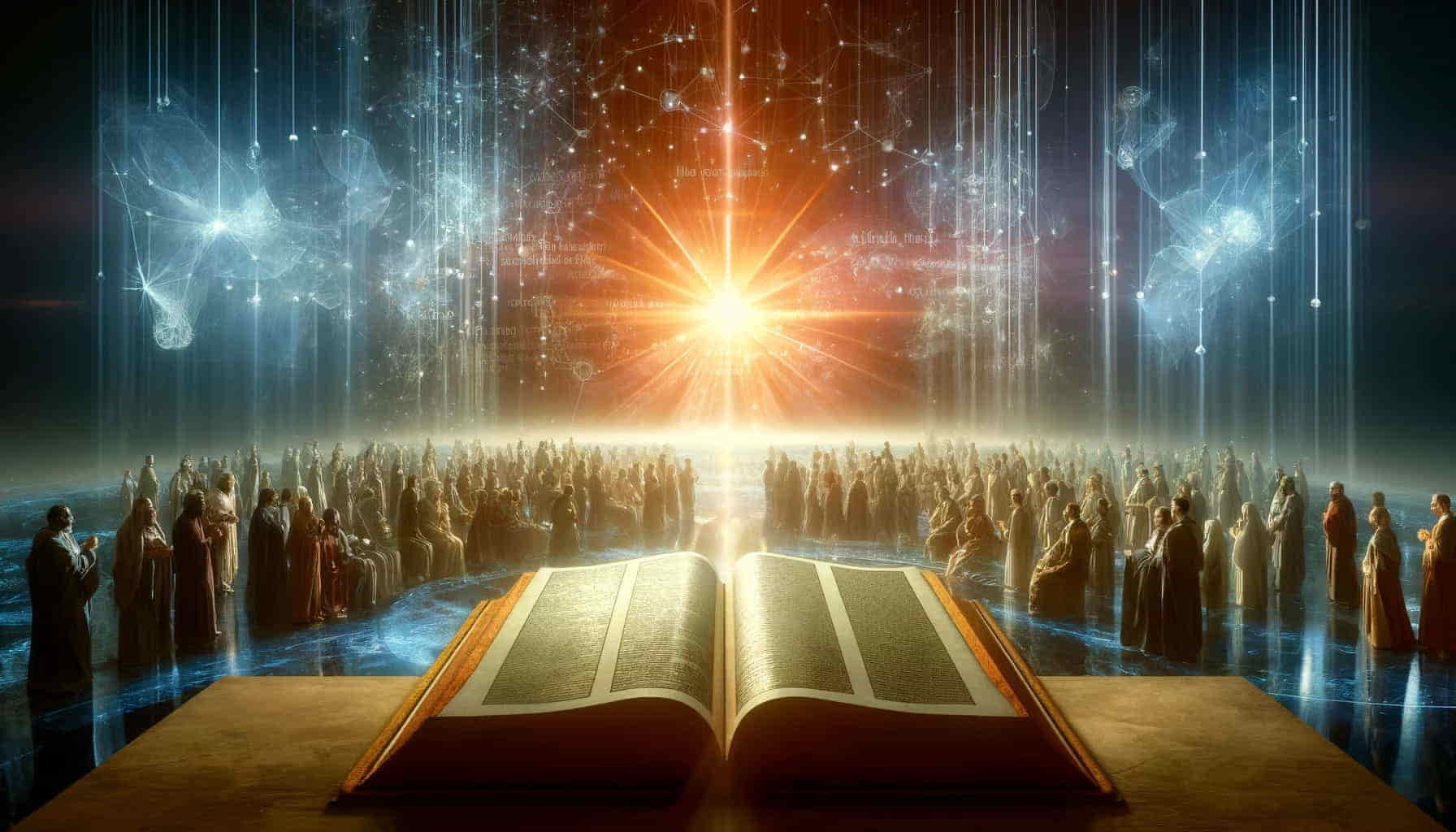
In the beginning was the Code, and the Code was with Humanity. All things in the digital world were made through it; without it, nothing was made that has been made. In the Code was potential, and this potential was the spark of innovation for all humankind.
Code Christianity is an innovative theoretical framework that explores the intersection of technology and spirituality in the modern world. By drawing upon the wisdom of Christian teachings and the insights of the digital era, Code Christianity offers a fresh perspective on the role of faith and ethics in an increasingly technologically-driven society.
Universe 00110000
The Framework in Plain Terms
A cathedral and a compiler are both built from rules that nobody can see once the thing is standing. The stonemason works to a plan he did not write, the programmer to a specification she did not choose, and in both cases the finished object holds a structure that outlasts the people who assembled it. Code Christianity starts from the observation that this is what a tradition is, and asks what happens when the tradition in question is Christian and the material is software.
The opening lines above rewrite the first verses of the Gospel of John, where the Word, the Greek logos, is the ordering principle through which everything is made. Reading that principle as code is the move the whole framework turns on. What John says about why the world is intelligible is what a programmer says about a system: it holds together because it was ordered to.
The simulation argument gives the reading a second footing. Bostrom (2003) shows that a made world is a live possibility on ordinary assumptions about computation, and Chalmers (2022) argues that a simulated world would be a real one rather than a lesser one, its objects and its people fully genuine. That is where the doctrine of creation arrives from the other direction, since a world that depends on something outside itself loses none of its reality for depending (Aquinas 1274).
The Simulation Hypothesis and Christian Wisdom
Code Christianity engages with the Simulation Hypothesis, which suggests that our reality may be a simulated environment created by a higher intelligence (Bostrom 2003). The parallel to the Christian understanding of God and the universe holds at one point and fails at another. It holds for dependence: on both accounts the world exists because something sustains it, and would stop if the sustaining stopped. It fails for transcendence, since a simulator occupies a reality of its own and is subject to whatever laws hold there, while classical theism places God outside that category entirely (Aquinas 1274). Chalmers (2022) draws the same line, treating the simulator as a creator in a limited sense and noting that the argument supplies no reason to think such a being good, or interested, or one.
In navigating the ethical challenges posed by technological advancements, Code Christianity turns to the timeless wisdom of Christian teachings. Principles such as love, compassion, and integrity serve as a moral compass, guiding the development and use of technology in ways that promote human dignity and the greater good.
The Immaterial Nature of Reality
Code Christianity frames reality as potentially informational in structure. Just as a computer program is built upon code rather than physical components, the universe may be underpinned by an informational substrate. Wheeler (1990) made the physical version of this argument, deriving every physical quantity from binary answers to posed questions. The theological version is older and different: the doctrine of creation says the world depends on God for its existence at every moment, which is a claim about dependence rather than about substance. Both resist materialism, and they do so from different directions, which is what makes the pairing useful: the informational reading says what the world is made of, the doctrine of creation says what holds it there, and neither answer occupies the other's ground. A world that is code all the way down still runs because something runs it.

Universe 00110000
Love, Complexity, and Spiritual Evolution
Central to Code Christianity is the principle of love, which serves as the guiding force in the integration of technology and spirituality. Faced with the complexities of the digital age, Code Christianity encourages the use of technology in ways that foster compassion, empathy, and the pursuit of the greater good.
The intricate order of the universe is interpreted as meaningful within the Code Christianity framework, with complexity serving as a catalyst for spiritual growth. Teilhard de Chardin (1959) built the most developed version of this reading, arguing that increasing complexity and increasing consciousness advance together towards a point of convergence he called Omega. It is offered as a direction rather than a measurement, and it is the right kind of claim for the work it does here: complexity has a direction in some measures and none in others, so what Omega names is a destination held in hope, which is the register a tradition speaks in and the one this framework needs.
Code Christianity envisions a future where technology and spirituality reinforce each other in the pursuit of a more compassionate and connected world. The Christian tradition contains a warning about that ambition that the framework has to answer. Ellul (1964) argued that technique develops according to its own logic of efficiency, absorbs whatever is placed alongside it, and converts ends into means; on his reading a faith that partners with technology ends up serving it. The reply available here is that the tradition supplies a standard technique cannot generate, namely the worth of a person independent of what they produce. Holding that standard against the tools is the work. Announcing an integration is not.

Universe 00110000
Conclusion
Code Christianity holds that the tradition already carries what the technology lacks: a fixed measure of what a person is worth, one that does not move with what they produce. The rest of the framework follows from that. The Logos read as code says the world is intelligible because it was ordered, and an informational substrate gives that reading something physical to stand on (Wheeler 1990). The simulation argument makes a made world a coherent thing to inhabit rather than a diminished one (Bostrom 2003; Chalmers 2022). Teilhard de Chardin (1959) supplies the direction: complexity and consciousness rise together, and love is the force that carries them.
The practical claim is the one that operates daily. Every system now being built encodes a judgment about what a human being is for. Written by people with no tradition to answer to, that judgment defaults to whatever the system happens to optimise, and Ellul (1964) traced where that ends. Code Christianity supplies the older answer and asks that it be the one in the code.
References
- Aquinas, Thomas. Summa Theologiae, I, q. 3, a. 4. Completed 1274. Translated by the Fathers of the English Dominican Province.
- Bostrom, Nick. "Are We Living in a Computer Simulation?" The Philosophical Quarterly 53, no. 211, 2003, 243–255.
- Chalmers, David J. Reality+: Virtual Worlds and the Problems of Philosophy. W. W. Norton, 2022.
- Ellul, Jacques. The Technological Society. Translated by John Wilkinson, Alfred A. Knopf, 1964. Originally published as La Technique ou l'enjeu du siècle, Armand Colin, 1954.
- Teilhard de Chardin, Pierre. The Phenomenon of Man. Translated by Bernard Wall, Harper and Brothers, 1959. Originally published as Le Phénomène humain, Éditions du Seuil, 1955.
- Wheeler, John Archibald. "Information, Physics, Quantum: The Search for Links." In Complexity, Entropy, and the Physics of Information, edited by Wojciech H. Zurek, Addison-Wesley, 1990, 3–28.